
When Voting Meant Jail
The Trial of Susan B. Anthony

Writers note: I drafted this month’s newsletter ahead of the Supreme Court’s 6-3 decision in Louisiana v. Callais gutting Section 2 of the 1965 Voting Rights Act. While this story is focused on a specific aspect of white women’s quest for suffrage, the fight for political recognition for women and minorities in the United States has always been intertwined. History shows us that as Frederick Douglass once said, “Power concedes nothing without a demand.”
“Here is conceded the power only to prescribe the times, places, and manner of holding the elections, and even with these Congress may interfere with all excepting the mere place of choosing Senators. There is not the slightest permission for the states to discriminate against the right of any class of citizens to vote. Surely to regulate cannot be to annihilate! Nor to qualify, to wholly deprive.” Susan B. Anthony, 1873
For many Americans, voting is a routine activity. We receive our ballot information in the mail, review the proposed initiatives and candidates vying for office. We suffer through the nonstop deluge of campaign texts, emails, and advertisements all clamoring for our vote, attention, and dollar. Then when the time comes, we make our selections and await the results. Some voters are much more invested in the process and might decide to canvass for their preferred candidate or sign up to be a poll worker on Election Day. However, for most, participation and engagement ends at casting a ballot. And for the lucky, it is a quick and largely forgettable activity.1 Yet, in the nineteenth century, casting a ballot as a woman could get you arrested. In 1872, that is exactly what happened to Susan B. Anthony.
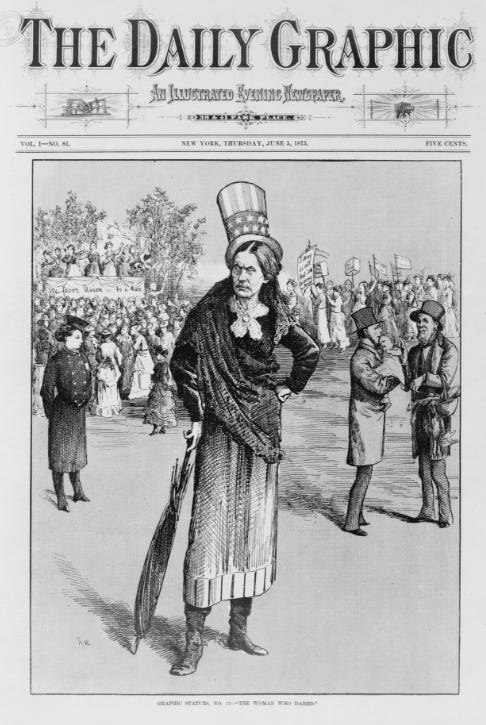
Anthony was born in in Massachusetts in 1820 - a century before the federal government would ratify the 19th Amendment confirming a person’s right to vote “shall not be denied or abridged by the United States or by any State on account of sex.”2 Heavily influenced by her Quaker upbringing, Anthony was a staunch believer in the abolitionist cause, finally joining the movement after her family moved to Rochester, New York in 1845. After becoming a teacher in 1848 and discovering that female teachers received considerably less in salary than their male colleagues, Anthony expanded her activism to incorporate gender equality - which eventually included the right to vote.3
In 1851, Anthony met Elizbeth Cady Stanton. Stanton was also part of the women’s rights movement and was largely known for spearheading the first woman’s rights convention in 1848 in Seneca Falls, New York. Together, the duo would dedicate decades to fighting for women’s rights and enjoyed a friendship that lasted the rest of their lives. After Reconstruction failed to expand the franchise to women, Anthony and Stanton established the National Woman Suffrage Association (NWSA) with the primary goal of securing a federal amendment to the constitution granting women the right to vote. There were some, however, who believed that the 14th Amendment extended the franchise to women — including Anthony.4
Their argument, known as New Departure, was based in how one chose to interpret the 14th and 15th Amendments. Under the 14th Amendment, all persons “born or naturalized” in the United States - and subject to its jurisdiction - were considered citizens. Those who held this belief argued that women born in the United States were citizens and thus were guaranteed the privileges of said citizenship, including the right to vote. Anthony and others sought to prove their argument by posing various legal challenges in federal courts, hoping to win a judgment in their favor confirming that the amendments had redefined citizenship in such a way that it actually extended the franchise to women and thus negated the need for a separate constitutional amendment.
After overwhelming a worker at the registrars office by citing the 14th Amendment, Anthony and several other women registered to vote in New York’s federal election in 1872. When Anthony arrived at her polling place to cast a ballot she was challenged and forced to answer three questions: was she a citizen, did she live in the district, and had has accepted any bribes in exchange for her vote. She was not asked about her gender. After answering to the challenger’s satisfaction, Anthony proceeded with voting. Just over a week later, U.S. Commissioner William Storrs issued a warrant for Anthony and her colleagues’ arrest due to a complaint filed by a local poll watcher who argued the women who voted did so in defiance of the Enforcement Act of 1870.
One of the main issues was whether Anthony knowingly violated the law, a requirement to secure conviction. Anthony’s attorneys argued that Anthony believed she had a right to vote due to the 14th Amendment and thus could not be convicted. The Assistant US Attorney rebutted this claim by producing a report written by a member of the U.S. House of Representatives at the request of suffragists which clearly stated that the Reconstruction amendments did not expand the franchise because they “in no way altered the authority of states to determine qualifications for voters.” This, the prosecution argued, was clear evidence that Anthony knew she did not have the legal authority to vote; it was not a simple misunderstanding or misinterpretation of the amendment - Anthony was guilty and should be convicted.5
Anthony stood charged with voting without the “legal right to vote in said election district” in the state of New York because she was a “person of the female sex.” She pled Not Guilty. Ahead of her trial, Anthony went on a speaking tour giving a talk titled “Is it a Crime for a U.S. Citizen to Vote?” where she shared the historic arguments for her cause and highlighted the sexism and double standards at play saying partially, “there is no constitutional ground for the exclusion of women from the ballot-box in the State of New York. No barriers, whatever, stand to-day between women and the exercise of their right to vote, save those of precedent and prejudice.”6
Anthony visited twenty-nine villages within Monroe County where her case was to be held and her speech was printed in full in a Rochester newspaper. Anthony’s trial finally began on June 17, 1873 where a jury of 12 men would decide her fate - so much for a jury of her peers (something Anthony commented on herself during the trial). If you listened to the latest episode of the show, then you know that Anthony ultimately lost her case. Anthony died before she could achieve her goal of female suffrage in the United States as the campaign for women’s suffrage lasted another several decades, with the ratification of the 19th Amendment in 1920 extending the vote to (most) women. For Black women, true parity wouldn’t come until the 1965 Voting Rights Act when President Johnson signed legislation preventing race-based discrimination in voting.7
In recent years, the Voting Rights Act has been under threat, most notably in the 2013 Supreme Court decision in Shelby v. Holder which got rid of Section 5, also known as “pre-clearance.” In the simplest explanation, the provision mandated that before any state or locality with a history of racial discrimination made any changes to voting practices it had to receive approval - or “pre-clearance” by the federal government.8 These challenges remind us how tenuous political rights are and how important it is to stay vigilant and remain engaged in the process. As it stands, the Equal Rights Amendment still is not ratified and there are a series of court cases making their way through the docket seeking to overturn what we would otherwise consider long established legal precedent.9 In these unsteady moments, knowing our history is a critical tool to standing firm against those who would seek to weaponize the past for political means. Now more than ever we should listen to the experts and stand in solidarity with those who have been in this fight the longest. Our rights may just depend on it.
OAH
I am writing this several days after returning from Philadelphia and I am not sure my feet have fully touched the ground. I always enjoy attending history conferences - the panels are always diverse and my biggest problems are usually trying to see every session I want to and making sure I remember to eat! This year’s conference brought out some pretty big names in the historical space. I was joking with friends ahead of time that I was going to the Historians Oscars and I must have put something into the universe because it sure felt like I was walking among some of the greats. I ran into - literally - Liz Covart from the illustrious and game-changing podcast Ben Franklin’s World - and I kept seeing the esteemed David Blight every time I turned around. Of course, OAH president Annette Gordon Reed was making her rounds and I was so nervous asking a question in a panel she was sitting in (as an audience member!) that I used the wrong word. So - you know - cool.
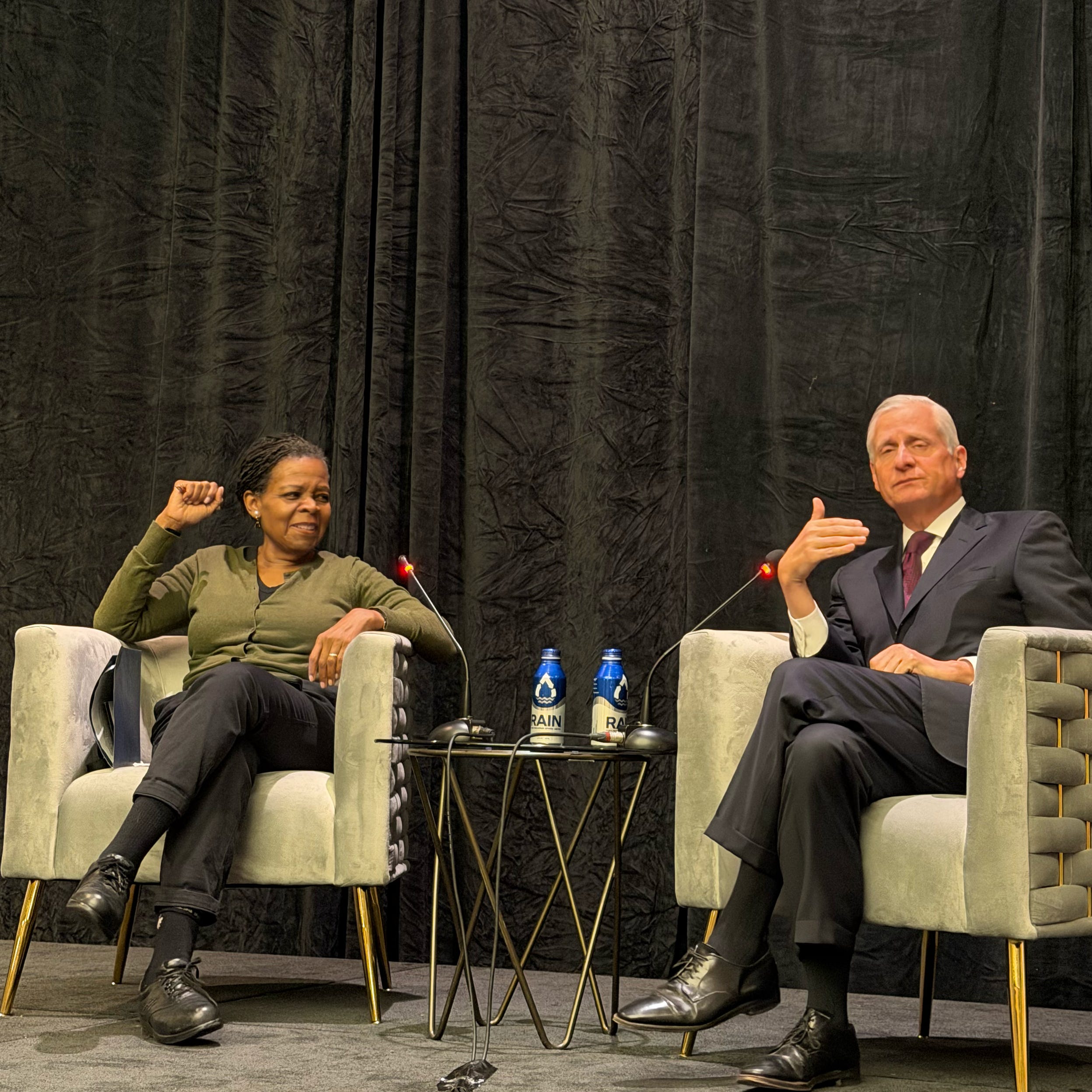
Yet, I also walked away incredibly inspired. I had insightful and engaging conversations with incredible scholars and peers and I was reminded that despite the fact that it can sometimes feel like I am a small fish in a big pond, we’re actually all swimming together trying to make sure we succeed and we’re all a bunch of dorks who really admire each other. I look forward to future opportunities to connect and collaborate and I thank the individuals who took the time to sign their book, answer some questions, or just simply let me nerd out a bit. It meant the world to me.
On My Bookshelf
Between traveling and writing projects, I had to be very diligent to keep up on the reading train last month, yet I still somehow managed to get through seven books! I had several titles to get through for future guest appearances while also navigating the doorstop that is T.J. Stiles’s biography of Cornelius Vanderbilt, The First Tycoon. That book is massive, folks. If you ever wanted to know the most intimate details of Vanderbilt, Stiles is your guy! It was incredibly detailed and I found sometimes Stiles veered a little too much into the American story to provide context for Vanderbilt, but overall it was a thorough, well researched look into a man who heavily influenced our modern economy.
I also picked up Clutch by Emily Nemens for book club and I have to say peeps - I was underwhelmed. The characters were very hard to empathize with and I kept feeling like I was waiting for something to happen. I shared with my pals that it felt like the story lacked an arc - there was no third act. Nemens built a world with characters who lived throughout the United States, and some of her descriptions of said cities and surrounding areas felt surface at best and the lack of accuracy became distracting. One of the characters includes someone from my home turf of Northern California and there were both overplayed stereotypes (writing about homeless people in areas of the city where you will not find them) as well as geographical errors (discussion about moving to “Marin” which is a county, not a town). There were also some negative tropes about Manhattan that felt a little overdone that just pulled me from the story which was unfortunate since I really wanted to like the book. Looking ahead to May, I have a few more titles for future guest spots and a growing list of books to get through for pod research that I am excited about. What are you reading this month?
On the Podcast
April was another great month for the show - I continued my journey through the Gilded Age, exploring something a little different with my look into the Gilded Age estate and finally wrapped up my coverage of the Garfield presidency and the drama that it wrought. I was also so excited to finally release my conversation with Dr. Austin McCoy about his incredible book Living in a D.A.I.S.Y. Age and share the delightful conversation I had with Shannon McKenna Schmidt about her latest You Can’t Catch Us.
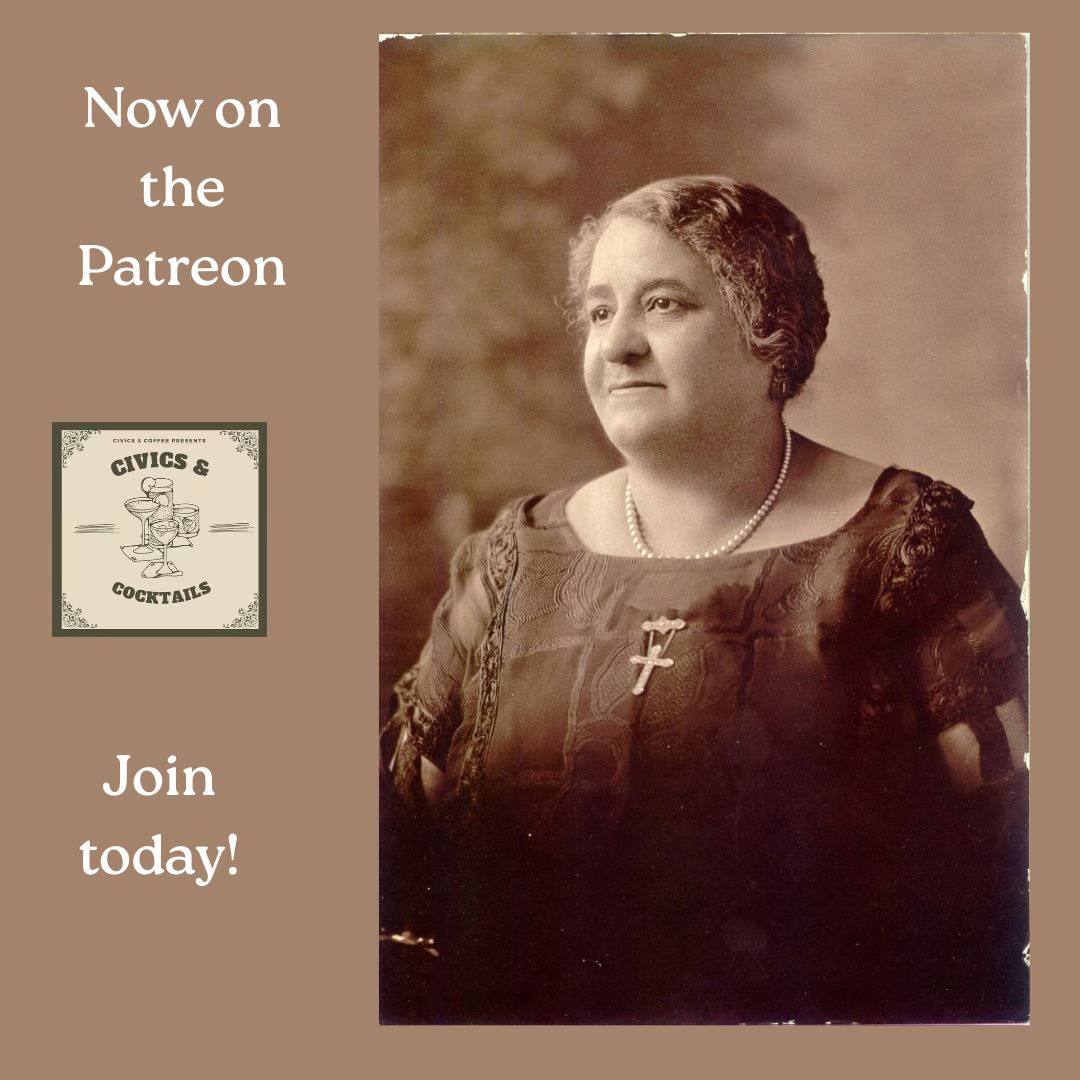
Over on the Patreon, I welcomed Shaydra and Ayala to discuss one of the most underrated women I’ve come across in a long time, Maggie Walker. One of the things I adore about the Patreon (other than I get to gab with girlfriends about history) is that I get to dive into some pretty fantastic topics and people. If you like Civics & Coffee, consider joining the Patreon - it’s one of the best deals around and the subscription gets reinvested into the show.
I am amazed that we are already five months into 2026 and that summer is right around the corner. How? What are your summer plans? I am bound and determined to get some research done this summer for a non-podcast related project (I did get some in last fall, so there is hope!) and hopefully get some writing done? Who knows! As always, you can expect freshly brewed episodes to great your Saturday mornings.
Until next time friends,
Alycia
This is not the case for too many Brown and Black Americans who face voter discrimination every election cycle and who usually have to prove who they are repeatedly every 2 to 4 years simply to caste their ballot. They often get stuck in bureaucratic nightmares and are forced to cast provisional ballots - if they are lucky enough to not be turned away. This is not the sign of a healthy democracy and in 2026, our voting system should not be this way.
Paula A. Monopoli. “A ‘New’ New Departure.” Washington University Law Review. Accessed April 26, 2026. (LINK); O’Neill, William L. “The Fight for Suffrage.” The Wilson Quarterly (1976-) 10, no. 4 (1986): 99–109. http://www.jstor.org/stable/40257060.
Ann D. Gordon, ed. “The Trial of Susan B. Anthony.” Federal Trials and Great Debates in United States History. Federal Judicial Center. 2005. (LINK)
Trump v. Barbara seeks to challenge birthright citizenship, while there is a chance another case surrounding the access to mifepristone may end up in the court’s docket sooner rather than later which will directly impact a woman’s access to reproductive healthcare.